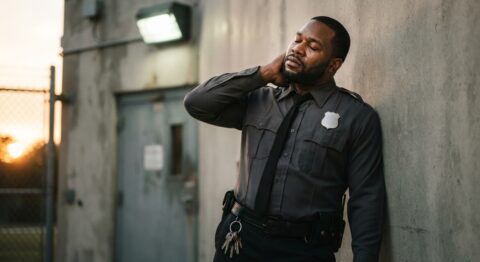
Not quite a police officer, not just a bystander — the security guard occupies a specific middle ground in the uniform fantasy: real authority over a space, without the full weight of law enforcement behind it. Gay security guard dating draws on exactly that in-between quality, and it’s a real, licensed profession, not an improvised look.
An industry with a real 175-year history
Private security as a modern industry traces directly back to 1850, when Allan Pinkerton — a Scottish immigrant who’d worked as a barrel maker before stumbling into a counterfeiting investigation almost by accident — founded the Pinkerton National Detective Agency in Chicago. The Pinkertons made their name protecting railroads from robbers at a time when local law enforcement had neither the authority nor the resources to chase outlaws across state lines. It wasn’t until the 1940s that the company began shifting toward the guard-based security work people associate with the industry today, and by 1990, more than 98 percent of Pinkerton’s business was providing security guard personnel rather than detective work. The uniform you’re picturing has roots in that same 175-year-old institution, even if almost nobody wearing it today has ever heard the name.
A licensed job with real requirements
In the UK, working as a security guard legally requires an SIA licence from the Security Industry Authority — issued only after a dedicated training course (typically run over three days), a criminal background check through the DBS, and, since April 2021, mandatory first aid training beforehand. The licence itself is only valid for three years before it needs renewing. In the US, requirements vary by state, but armed and unarmed guard roles typically both require licensing, background checks, and in many states, specific hours of training before anyone is legally allowed to work the job. This isn’t a role anyone talks their way into — there’s real vetting behind that uniform.
A much bigger workforce than most people realize
The security industry is genuinely massive and mostly invisible as a category. In the US alone, roughly 2.8 million people work in the field, with more than 1.5 million licensed guards specifically, spread across more than 8,000 private security firms nationwide — over 85 percent of Fortune 500 companies contract at least some of that workforce directly. The UK employs just over 200,000 people in private security services, an industry that’s grown steadily, up about 2 percent a year over the past five years. That’s a genuinely large, varied workforce, even though it rarely gets discussed with the same visibility as police or fire service. Broader research on LGBTQ+ workers backs up why discretion still matters here: surveys consistently find that more than 45 percent of employees across industries report hearing anti-LGBT remarks at work, and roughly 6 percent of the overall workforce identifies as LGBT. Security work, drawn heavily from traditionally conservative, male-dominated hiring pools, doesn’t have specific data showing it’s better or worse than that average — which itself says something about how little dedicated attention this particular profession gets compared to more visible uniformed roles.
Authority without the badge
Part of what makes this fantasy distinct from a police officer or soldier is the specific flavor of control it represents: a security guard commands a space — a building lobby, an event, a construction site — without carrying the full institutional weight of the police or military behind him. It’s authority that’s personal and immediate rather than backed by a whole system, and for a lot of GayCharlie members, that particular register is exactly the appeal.
Shift work built around everyone else’s schedule
Security work runs overnight as often as during the day, frequently on rotating shifts that flip a guard’s entire schedule from one week to the next. Night shifts in particular are common and often unavoidable, since a lot of the job exists specifically to cover the hours other people aren’t around. A dating app built around normal daytime availability doesn’t account for someone whose “morning” starts at 7 p.m.
Two audiences, one uniform
Some members are specifically hoping to meet a working security guard. Others are drawn to the role itself — someone watchful, alert, quietly in control of a space without needing to prove it loudly. GayCharlie doesn’t force either group to justify their interest to fit some narrower definition of the fantasy.
Discretion built into a job that’s often solitary
A lot of security work happens alone or in small teams, overnight, with long stretches where nobody’s watching the guard himself. That isolation cuts both ways — less workplace scrutiny day to day, but also fewer built-in opportunities to meet people the ordinary way, and less of the kind of visible peer network that professions like nursing or aviation have built over decades. It’s exactly the kind of gap a platform built around real profiles and flexible scheduling exists to close, rather than assuming everyone’s free on a Friday night.
Meeting a gay security guard starts here
Whether you searched “gay security guard dating,” the quiet authority of the role has always done it for you, or you’re after someone who notices everything without saying much, this is a licensed, real profession behind the fantasy — not a rent-a-cop stereotype, and one of the largest uniformed workforces that almost nobody talks about — if it’s the uniform itself that draws you in, not just the profession, gay uniform chaser dating is worth a look too.