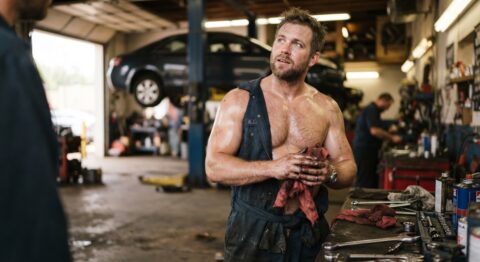
Grease under the fingernails, a coverall unzipped halfway in the summer heat, forearms that do actual physical work all day — gay mechanic dating runs on an appeal that’s almost the opposite of a pressed military uniform: nothing polished about it, and that’s exactly the point.
A trade you actually have to earn
In the US, becoming a fully certified technician usually means earning ASE certification — the industry-standard credential — which requires two years of hands-on, on-the-job training, or one year of experience combined with a two-year automotive degree. Technicians sit written exams covering specific systems (engine repair, brakes, electrical, and more), and have to recertify every five years to keep the credential current. In the UK, the equivalent path usually runs through an NVQ or apprenticeship, often three to four years combining paid work with formal training. Either way, this is a skilled trade with real testing and real standards behind it, with barriers to entry most people never notice from the outside.
A workplace culture that’s slowly, publicly changing
The skilled trades broadly, mechanics included, have historically carried one of the more traditionally masculine, sometimes openly unwelcoming workplace reputations of any industry on this list — and organizations built specifically to change that are a genuinely recent development. Groups like the Build Out Alliance, focused on LGBTQ+ professionals across building and construction trades, and grassroots efforts like Pride in Construction, founded after a tradeswoman publicly documented the harassment she faced on job sites, exist precisely because the culture hasn’t caught up everywhere yet. That’s an honest, current picture rather than a solved problem — real organizing is still actively underway, not a historical footnote.
A different kind of masculinity on display
Where a pilot’s appeal is polish and a doctor’s is quiet intellectual authority, the mechanic fantasy runs on physical, hands-on competence — someone who can diagnose a problem by sound alone, who’s strong enough to horse a stuck bolt loose without a second thought. It’s a more working-class register of the uniform fantasy, and for plenty of GayCharlie members, that’s precisely what sets it apart from the more buttoned-up versions elsewhere on the site.
Hours that don’t run on a dating app’s schedule
Part of why those hours are so brutal is a real, well-documented labor shortage: the US automotive industry currently sees roughly 70,865 annual technician openings against a projected supply of just 50,085 new entrants, a shortfall of nearly 21,000 a year, and industry-wide need across related technician sectors runs even higher against what trade schools actually graduate. Almost a third of repair shop owners name the technician shortage as their single biggest operational challenge. That shortage translates directly into overtime: independent shops and dealerships alike often run six-day weeks, and a backed-up service queue can easily turn a scheduled 6 p.m. finish into 8 or 9. Weekends are frequently the busiest stretch, not the time off a lot of other jobs treat as standard — which means a mechanic’s dating availability rarely lines up with when everyone else on a generalist app is actually online and looking.
More than one version of the fantasy
Some members are specifically after an actual mechanic, grease and unpredictable hours included. Others are drawn to what the trade represents more broadly — competence with your hands, a kind of unbothered physical confidence, someone who fixes things instead of talking around them. That physical, practical register is part of what separates this fantasy from the more institutional uniforms on the site: nobody in a shop bay is performing authority for an audience, the competence just has to actually work, every single time, or the car doesn’t leave the lift. Both are entirely valid reasons to be here, and neither requires an explanation to be taken seriously.
A trade where being out isn’t always simple
Auto shops remain one of the more traditionally masculine, blue-collar workplace cultures, and plenty of gay mechanics describe staying fairly private about their personal life on the job even when they’re completely open everywhere else. That’s not a judgment on the industry, just a real, common pattern reflected in exactly why groups like Build Out Alliance exist in the first place — and it’s exactly the kind of situation GayCharlie’s discretion tools were built around: a neutral profile photo, a private album unlocked only when you choose to, nothing visible without explicit approval.
Meeting a gay mechanic starts here
Whether you searched “gay mechanic dating,” the coverall-and-grease look has always done it for you, or you just want someone who’d rather fix the problem than talk about it, this is a real trade behind a real attraction — worth more than a fantasy that never leaves the garage, in an industry that’s genuinely, if slowly, becoming more open — the same pull that draws plenty of members toward uniform chasers more broadly, not just one trade.