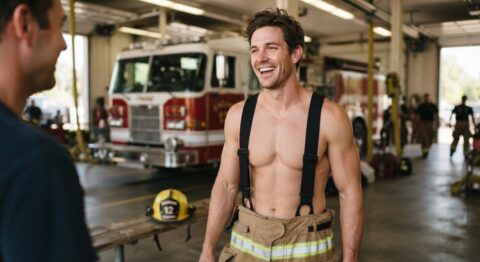
The gay firefighter fantasy has one advantage almost no other uniform on GayCharlie can claim: it’s also one of the most openly celebrated, mainstream heartthrob archetypes in the wider culture, with real money, a real cause, and real charity work behind it.
Started on the Gold Coast, for a reason that had nothing to do with looks
The Australian Firefighters Calendar began in 1993 on Queensland’s Gold Coast, and its original purpose was specifically to fund research into childhood burns treatment through the Children’s Hospital Foundation — a cause directly connected to what firefighters actually do, not an afterthought attached to a beefcake calendar after the fact. A Gold Coast firefighter named Bruce Mitchell took over running the calendar in 2002 and grew it steadily for the next thirteen years. It was later expanded to an international scale by David Rogers, a longtime fan of the project who partnered with Mitchell and, with his own partner Sharon, pushed the calendar’s reach dramatically further. Today the calendar reportedly hangs on walls in more than 90 countries and has raised in excess of $3.45 million for causes including childhood burns research, animal welfare, and disaster recovery.
Two separate roads to the same image
That’s the interesting split: mainstream culture built its firefighter-as-heartthrob imagery through calendars, marketing, and pop culture largely from the 1990s onward. Gay culture got there decades earlier, through the same Tom of Finland tradition that shaped so much of the broader uniform aesthetic — turnout gear pulled half off, suspenders, the specific mix of physical strength and rescue-hero appeal that Laaksonen was drawing in the mid-20th century, long before a fundraising calendar existed. Two very different origins, converging on the same image, one built around a real childhood burns charity, the other built inside gay bar and leather culture — neither one borrowing from the other, both arriving at the same conclusion independently.
Why firefighters specifically carry this weight
Part of what sets the firefighter apart from other uniformed authority is that the heroism is built into the job itself, not implied by a badge or a rank. Running into a burning building for a stranger is about as close to a universal definition of courage as exists — there’s no ambiguity about what the uniform means the way there sometimes is with more contested forms of authority. Add the physical demands the job requires day to day, and the appeal isn’t really a stretch: it’s a fairly direct read of what the uniform represents.
Visibility inside the profession itself, and its limits
Fire service culture has historically carried a reputation as hypermasculine and insular, which has made it genuinely harder for gay firefighters to be visibly out compared to some other public-facing professions. That’s shifted over the past decade — Los Angeles named Kristin Crowley its first openly LGBTQ+ Fire Chief in 2022, and organizations like the International EMS & Firefighters Pride Alliance now exist specifically to support LGBTQ+ professionals in fire and emergency medical services across the US and internationally. But the culture hasn’t uniformly caught up with the mainstream image on the calendar — plenty of gay firefighters remain selectively private on the job even now, which is its own quiet acknowledgment that the fantasy and the everyday reality of the firehouse aren’t always the same thing.
A calendar built on real firefighters, not models
Part of what’s kept the Australian Firefighters Calendar credible for over three decades is that its subjects are working firefighters, not hired models playing a part — a detail that matters for exactly the same reason it matters on GayCharlie: the fantasy holds up so much better when the person behind it is real. Some of the crews featured have described the project as a genuine source of pride within their stations, not an outside imposition on the culture.
What this means for the fantasy today
Knowing the calendar’s real history changes how the fantasy lands: this isn’t something gay culture appropriated or exaggerated on its own — it’s a documented, mainstream, decades-old phenomenon, started by a Gold Coast firefighter for a children’s hospital, that gay desire got to first and has kept pursuing since, on its own terms. The pull toward gay firefighter dating isn’t a costume fetish invented for an app; it’s one of the most broadly validated uniform fantasies there is, backed by real charity totals and three decades of receipts.