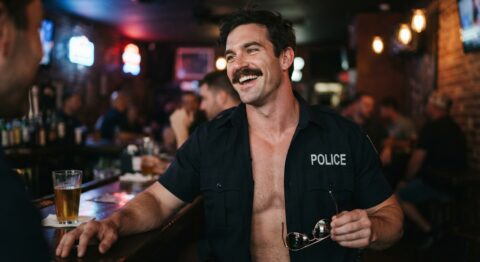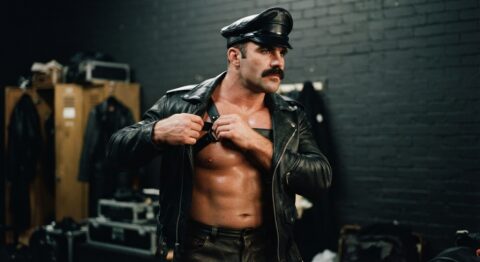
If you’ve ever wondered why a man in fatigues, leather, or a police uniform has such a specific hold on gay imagination, there’s a real answer, and it has a name: Touko Laaksonen, better known to the world as Tom of Finland.
Born in 1920, into a family of teachers
Touko Valio Laaksonen was born on May 8, 1920, in Kaarina, Finland, to a family of teachers, and showed an early pull toward the arts — drawing and piano both, well before anyone knew what either would eventually mean for gay visual culture. He moved to Helsinki in the autumn of 1939 to study at the Helsinki School of Sales and Advertising, a path that had nothing to do with the military at all, until history intervened.
A distinguished, decorated soldier — not a myth, a documented fact
Just weeks after the Winter War ended, Laaksonen was called up for military service in the spring of 1940, first serving in an anti-aircraft unit in Helsinki. When the Continuation War broke out in the summer of 1941, he was assigned to air defence duty at the Suomenlinna Sea Fortress. He wasn’t a passive observer of military life — he commanded his own air defence crew, and that crew successfully shot down a Russian aircraft, an action for which Laaksonen was awarded Finland’s Cross of Liberty medal. The man who would go on to define the gay military uniform fantasy for the rest of the 20th century wasn’t imagining the uniform from the outside. He wore it, commanded under it, and was decorated in it.
From private sketches to a global aesthetic
His drawings were first published in 1957, in the American magazine Physique Pictorial — the moment “Tom of Finland” as a name was born, kept deliberately separate from “Touko Laaksonen,” the name he continued using with family and colleagues for the rest of his life. From there, his work spread through underground physique magazines, then exploded into mainstream gay culture through the American leather and bar scene of the 1970s. The Village People, formed in 1977, took several of his archetypes — the soldier, the cop, the biker, the construction worker — and turned them into some of the most recognizable pop imagery of the decade, reaching an audience that had never seen Tom of Finland’s actual drawings but absorbed the aesthetic anyway.
Why the uniform specifically, and not just muscle
What made Tom of Finland’s work different from generic beefcake imagery was the specificity of the uniform itself — the way a tightly cut jacket or a pair of jodhpurs completed the fantasy rather than just showing off a body. Before Tom of Finland, gay men in art and media were mostly depicted as weak or effeminate caricatures; he replaced that entirely with hyper-masculine, powerful figures who were proud rather than apologetic, drawn by a man who’d actually served, actually commanded a crew, and actually been decorated for it. That lived experience is part of why the imagery reads as authentic rather than fantastical — it came from someone who knew exactly what the uniform actually felt like to wear.
A legacy that outlived the man
Laaksonen died on November 7, 1991, in Helsinki, at age 71. The Tom of Finland Foundation, established in Los Angeles in 1984, continues to preserve his work and support LGBTQ+ erotic art more broadly. His imagery has since been licensed for everything from fashion collaborations to a Finnish postage stamp — a level of mainstream recognition that would have been unimaginable during most of his working life, when this kind of art had to circulate quietly, often through the mail, to avoid obscenity laws.
What this actually means for uniform attraction today
Understanding where this fantasy comes from changes how it feels to have it. This isn’t a modern internet invention, a fetish that needs explaining away, or something to feel self-conscious about — it’s a documented, decades-deep current running through gay culture, created by a decorated combat veteran, with a direct line to why “uniform” remains one of the most searched, most discussed categories in gay dating today. Whether you’re drawn to military men, police officers, or firefighters, you’re participating in something with real cultural weight behind it, not chasing a trend.
Where the fantasy meets real people
The gap between Tom of Finland’s drawings and real dating has always been the hard part — an idealized illustration doesn’t introduce you to an actual soldier, cop, or firefighter, or to the community of admirers who share the same pull. That’s the specific gap GayCharlie exists to close: verified members who actually wear the uniform, alongside admirers who are simply drawn to it, in a space built around the fantasy’s real history rather than treating it as something to hide.