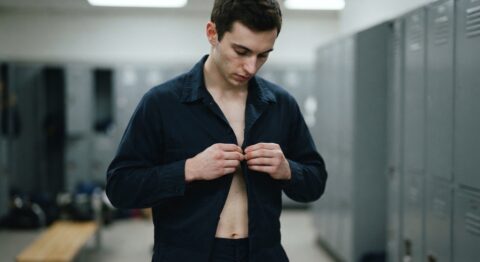
Ask ten different men why a uniform does something for them, and you’ll get ten different answers — but underneath the variation, there’s real, published psychological research that explains why this particular fantasy is so widespread and so consistent, not just a personal quirk.
The research behind why a uniform actually changes behavior
This isn’t just theory. Psychologist Leonard Bickman’s 1974 study, “The Social Power of a Uniform,” published in the Journal of Applied Social Psychology, is one of the most cited pieces of research on the subject. In a series of real field experiments, researchers dressed as either a civilian, a milkman, or a security guard approached strangers on the street with small requests — pick up a dropped paper bag, hand a dime to someone else, move away from a bus stop. People complied dramatically more often with the man in the guard uniform than with the same request from someone dressed as a civilian. The uniform itself, with no other information about the person wearing it, measurably changed how people responded to him. Separately, Stanley Milgram’s famous obedience research found that full compliance with an authority figure’s instructions dropped from 65 percent to just 20 percent when the experimenter swapped his white lab coat — itself a kind of uniform — for ordinary clothes. The coat alone was doing a huge share of the psychological work.
Structure and discipline read as reassurance
A uniform signals that someone operates inside a system with rules, standards, and accountability — discipline that’s been tested and proven, not just claimed. For a lot of people, that structure reads as safety as much as it reads as attraction: this is someone who’s been trained to stay composed, to follow through, to be reliable under pressure. It’s a very different kind of appeal than raw physical attraction alone, closer to trust than to lust, even when the two overlap heavily in practice.
Protection as an archetype, not just a job description
Military, police, fire, and rescue uniforms all share one thing in common: the person wearing one is, at least in theory, someone whose job is protecting other people, sometimes at real physical risk to himself. That protector archetype runs deep and predates any specific uniform — it shows up across cultures and throughout history in myth and story long before modern militaries or police forces existed in their current form. The uniform is a modern, specific expression of something much older.
Rarity does real psychological work
Part of why the fantasy stays potent is simple exposure: you don’t pass a man in dress uniform, or catch a firefighter walking out of a station in full turnout gear, every day. That scarcity means each real encounter carries more weight than it would if the image were constant — the brain treats infrequent, vivid stimuli differently than it treats the everyday. It’s the same basic mechanism that makes a chance encounter memorable when a routine one isn’t.
Authority without needing to ask for it
Bickman’s and Milgram’s research both point to the same underlying mechanism at work in dating attraction, not just compliance with instructions: a uniform grants a kind of default authority and credibility the moment someone puts it on, before he’s said a single word. People defer to it, get out of the way for it, listen more closely because of it. For a lot of GayCharlie members, that’s the actual core of the appeal — not physical dominance, but an ease and legitimacy that comes from institutional recognition rather than personal assertion.
Contrast between public duty and private self
There’s also something specific about the gap between a uniform’s public function and the private person underneath it — the idea of a man who commands a room, a scene, or a crisis, and then, off duty, is just as capable of vulnerability and tenderness as anyone else. That contrast between public authority and private softness is a recurring theme in how members describe the appeal, and it maps closely onto exactly the kind of dual identity that GayCharlie’s discretion tools were built to protect: public role during the day, private self after hours, with the choice of when the two intersect always staying with the member.
None of this needs justifying
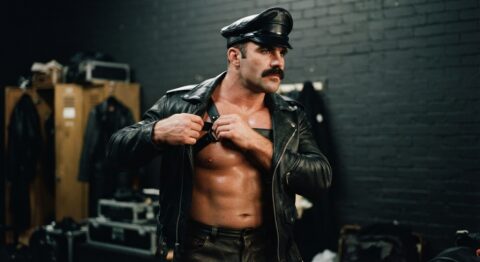
Whether the pull is toward structure, protection, rarity, authority, or the contrast between duty and privacy, none of it requires an explanation or an apology — and it isn’t just anecdotal, it’s backed by fifty years of published social psychology research on how uniforms actually change human behavior. This is one of the oldest, most consistently documented threads in gay attraction, running from Tom of Finland’s drawings in the 1950s straight through to a 2026 dating profile that lists “military” or “firefighter” as a preference. Understanding why doesn’t make the fantasy less real — it just makes it easier to stop second-guessing. If that’s the pull you’re working with, gay uniform chaser dating is built specifically around it.