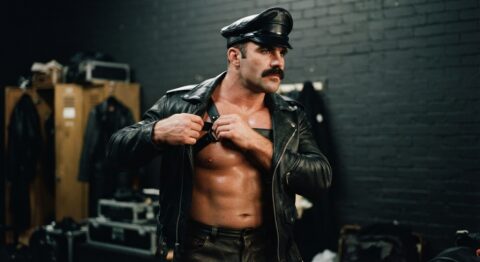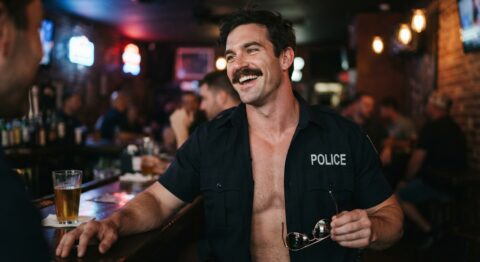
Four of the uniforms on this site — soldier, cop, and their close cousins — were turned into global pop culture by a band most people know for one song, and rarely for anything else about them. That band did more to mainstream the uniform fantasy than almost anything before or since, and the whole thing started in an actual gay bar, dreamed up over drinks — not in a conference room.
Born watching a real moment at a Manhattan gay club
The idea came from producers Jacques Morali and Henri Belolo, French-Moroccan music industry veterans who’d founded their production company, Can’t Stop Productions, in 1975. In 1977, the two were at the Anvil, an after-hours gay nightclub in Manhattan’s West Village, when they noticed a bartender named Felipe Rose dancing in a headdress and loincloth — an outfit that honored his own Native American father — he wasn’t performing, he was wearing his own heritage. As they watched, a man dressed as a cowboy approached Rose, visibly drawn in. Belolo later described the exact moment: “Jacques and I suddenly had the same idea… we started to fantasize what were the characters of America.” That single interaction, between two real men in a real gay bar, became the entire creative concept behind the group.
Built from a studio session, not a casting call
The group’s actual formation traces back to a Ritchie Family album Morali and Belolo were producing, which needed a strong male background vocalist. They recruited Victor Willis, who was performing in the Broadway production of The Wiz at the time, to sing on early tracks including “San Francisco,” “In Hollywood,” and “Village People.” Willis became the group’s lead voice, and Rose — already known to Morali and Belolo from the Anvil — was brought in as a founding member alongside him. The rest of the now-iconic archetypes — soldier, cop, construction worker, biker — were assembled afterward, cast specifically to complete the vision that started with one cowboy crossing a dance floor.
A direct line back to Tom of Finland
The archetypes the Village People built their entire visual identity around are the same ones Tom of Finland had been drawing since the years right after the Second World War — muscular men in tight, exaggerated versions of real working uniforms, radiating a confidence that had nothing apologetic about it. The band didn’t invent this imagery; they took an aesthetic that had circulated for decades within gay culture and put it on mainstream radio and television, uniform fantasy included, whether the general public clocked the reference or not.
Mainstream success built on a coded joke
“Y.M.C.A.,” released in 1978, became one of the best-selling singles of all time and remains a fixture at weddings, sporting events, and family functions worldwide — most of that audience with little to no awareness that the song, the band, and the uniforms were rooted directly in gay cruising culture, built by two gay producers, fronted by openly gay performers, born out of an actual cruise at an actual gay bar. That gap between what the song became and where it actually came from is itself part of the story: a piece of authentic gay iconography became so mainstream it functionally hid in plain sight for decades.
Why this history matters for the fantasy today
The Village People are proof that the uniform fantasy didn’t stay confined to gay subculture — it broke into the absolute mainstream, sold hundreds of millions of records, and is still played at stadiums today, soldier and cop costumes included, without most of that crowd making the connection back to where the imagery started, or to Felipe Rose and a cowboy at the Anvil in 1977. That’s a very different trajectory than most niche interests get, and it says something real about how deep and how broadly resonant the uniform fantasy actually is, gay or otherwise.
From disco costume to real dating intent
There’s an obvious gap between a costume built for a three-minute pop song and an actual date with a real soldier, cop, or firefighter — the Village People sold an image born from one real spark, not a template for an actual connection. That’s exactly where GayCharlie picks up: verified members who actually serve in these roles, alongside admirers who’ve carried this exact fantasy since long before they had a word for where it came from. Whether you’re drawn to military, police, or the uniform obsession itself, the through-line from a 1977 dance floor to a 2026 dating profile is more direct than most people realize.