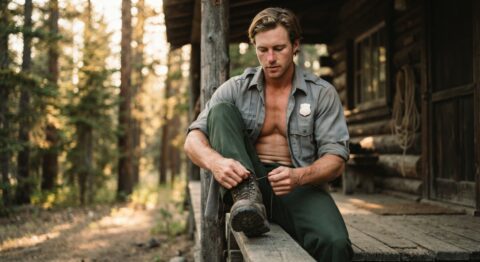
Flat-brimmed hat, boots built for miles of terrain, a quiet outdoorsman’s confidence — gay park ranger dating pairs the uniform fantasy with something most other entries on this list don’t have: wide open space, and a job that’s often a lot more armed and authoritative than people assume.
More law enforcement than most people realize
Law enforcement rangers are the primary police agency inside US National Park Service land — they carry firearms, make arrests, execute search warrants, and testify in court, exactly like any other federal law enforcement officer. Year-round rangers complete a 20-week training program at the Federal Law Enforcement Training Center in Glynco, Georgia; seasonal rangers go through a separate program covering at least 650 hours of coursework across criminal investigation, warrant execution, and arrest procedure. A lot of rangers are also cross-trained in wildland firefighting, emergency medical response, and search and rescue — meaning the same uniform can genuinely cover three or four of the archetypes on this list at once.
A shrinking workforce covering an enormous amount of ground
The National Park Service manages roughly 85 million acres — about 133,000 square miles — across more than 400 individual park units. Only around 1,150 commissioned law enforcement rangers patrol all of it nationally, which works out to one officer for roughly every 116 square miles. That number has been shrinking for decades: the NPS employed 2,471 commissioned rangers back in 1986, nearly double today’s total, with almost half of that decline happening just since 2010. The agency’s plainclothes special agents, who handle its most serious investigations, are down to only around 30 nationwide covering all 400-plus park units combined. That ratio is part of what makes ranger postings so distinct from almost every other uniformed job on this list: a single officer can be responsible for patrolling well over a hundred square miles essentially alone, backup potentially hours away rather than minutes.
Authority set against open landscape instead of a station
Where most uniformed authority plays out in a building, a precinct, or a base, a ranger’s beat is often hundreds of square miles of wilderness. That combination — real law enforcement power, exercised largely alone, in some of the most remote settings imaginable — gives the fantasy a different texture than a city cop or a base-bound soldier. It’s authority and self-reliance in equal measure.
Isolation that makes dating genuinely hard
Many ranger postings sit in genuinely remote park units, hours from the nearest town of any size, let alone a visible gay community. That isolation is a real, practical dating obstacle rather than a minor inconvenience, and it’s exactly the gap a platform with wide geographic reach and a real member base is built to close — rather than assuming everyone lives within a short drive of a city center. Seasonal rangers face an added layer: a posting that lasts only a few months before moving to a completely different park for the next season, making any kind of consistent local dating life close to impossible without a platform that travels with them.
The Park Service and LGBTQ+ history are more connected than people realize
The Stonewall National Monument, commemorating the 1969 uprising widely seen as a turning point for the modern gay rights movement, is itself a National Park Service site — meaning the same agency staffing 400-plus parks with 1,150 rangers is also the official custodian of one of the most significant sites in LGBTQ+ history. That connection has recently become a real, active point of tension: LGBTQ+ advocacy groups documented the removal of more than a dozen NPS webpages covering queer history in 2025, including edits to the Stonewall site’s own content. In response, a group of park rangers organized under the name “Resistance Rangers” and rebuilt more than 100 removed queer and transgender history pages on an independent site — rangers themselves choosing to preserve that history rather than let it disappear.
A role that blends several fantasies into one
Because so many rangers are cross-trained in firefighting, EMS, and search and rescue on top of law enforcement, the ranger fantasy often overlaps directly with the appeal covered elsewhere on GayCharlie for firefighters and first responders — physical competence, crisis response, someone equally at home making an arrest or pulling an injured hiker off a trail. It’s arguably the most multi-disciplinary uniform on this entire list, and members drawn to it often describe being pulled by more than one of those threads at once.
What members are actually drawn to
Some are hoping to meet an actual ranger, remote posting included. Others are drawn to the archetype itself — quiet self-sufficiency, comfort with both authority and total isolation, a man equally at ease alone in the backcountry or handling a genuine emergency. Both are welcome, no explanation required.
Meeting a gay park ranger starts here
Whether you searched “gay park ranger dating,” the flat-brim-and-boots look has always done it for you, or you’re specifically drawn to a man who’s armed, trained, and completely at home alone in the wild, this uniform carries a lot more real authority, and a lot more real isolation, than people give it credit for.