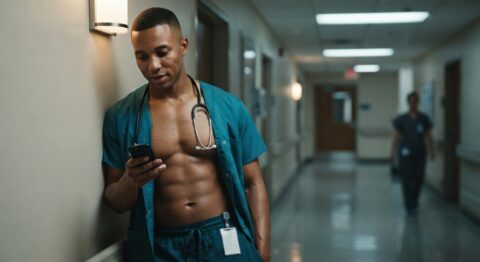
Scrubs don’t get the same reputation as a military uniform or a badge, and yet gay nurse dating has a real, steady following — built less on authority and more on something harder to fake: someone whose entire job is staying calm and competent while everyone around him is falling apart.
A profession under real, documented strain
This isn’t a small or shrinking field. In the US, the Bureau of Labor Statistics projects more than 193,000 registered nurse job openings every year through 2032, driven by both turnover and an aging population that needs more care, not less. The shortage already costs US hospitals an estimated $37 billion annually. In the UK, the picture is just as stark: England alone currently has over 43,000 unfilled registered nurse roles, and the NHS’s own long-term workforce plan says the system needs roughly 13,100 additional nurses every year through 2037 just to keep up. That’s not trivia — it means the men behind this fantasy are working brutal, understaffed shifts, which changes what dating them actually looks like.
A professional community with real history behind it
Gay men in healthcare have organized support for each other longer than most people realize. GLMA — originally founded in 1981 as the American Association of Physicians for Human Rights, growing out of the Bay Area Physicians for Human Rights in San Francisco — started as a doctors-only organization, but opened its membership to nurses and every other healthcare professional in 2002, formally renaming itself GLMA: Health Professionals Advancing LGBTQ Equality in 2012. That expansion mattered: it gave gay male nurses, specifically, an organized professional community and advocacy structure that didn’t exist for the first two decades of the association’s life. Today GLMA is the oldest and largest LGBTQ+ health professional organization in the world, and its existence is a real marker of how far healthcare culture has moved since 1981.
The appeal isn’t the uniform, it’s the composure
Where a military or police uniform reads as authority, scrubs read as competence under pressure — a different kind of attraction entirely. A nurse is the person who stays steady while inserting an IV into someone mid-panic, who can deliver bad news without flinching, who’s seen enough that very little rattles him anymore. For a lot of GayCharlie members, that’s the actual draw: not power over others, but a kind of grounded reliability that’s hard to fake and easy to recognize.
Shift work that makes generalist dating apps pointless
Hospital nursing runs on rotating 12-hour shifts, nights as often as days, frequently with mandatory overtime layered on top given how understaffed most units already are. A dating app built around evening availability and quick replies just doesn’t work for someone who’s coming off a 12-hour night shift and needs to sleep through most of the next day. What actually works is a platform where “I just got off a double” is understood immediately, not treated as an excuse.
A field that has long included a visible share of gay men
Nursing, like a handful of other caregiving and cabin-crew-adjacent professions, has historically counted a notable proportion of openly gay men among its ranks — a pattern widely acknowledged inside the profession rather than an outside assumption. It’s part of why the fantasy has real substance behind it rather than existing purely as an outsider’s projection: there’s a genuine, sizeable community of gay men in scrubs, backed by an actual professional organization, not just a trope.
Male nurses are already a minority within the profession
Before even factoring in orientation, male nurses are a genuine minority in their own field. In the US, men now make up roughly 11 to 13 percent of the registered nurse workforce, up from just 8 percent in 2015 and less than 3 percent back in the 1970s — a real, measurable shift, but still a small slice of a profession that remains heavily female. The UK sits at almost exactly the same figure, around 11 percent. That context matters: a gay man in nursing is a minority within a minority, which is part of why the men who do choose this path, and stay in it despite the punishing hours documented above, tend to be genuinely committed to the caregiving side of the job rather than drifting into it by default.
What members are actually looking for
Some GayCharlie members are hoping to meet an actual nurse, understaffing and unpredictable schedule included. Others are drawn more to what the role represents — steadiness, care, someone who can handle chaos without losing his composure. Both are welcome here, and neither has to explain themselves to get taken seriously, which is more than most generalist apps offer.
Meeting a gay nurse starts here
Whether you searched “gay nurse dating,” you’ve got a thing for scrubs specifically, or you just want someone who won’t panic when your life does, GayCharlie is built for exactly this kind of specific, real attraction: an actual profession under real pressure, backed by a real community, not a look borrowed for one night — the same appeal explored more broadly on our uniform chaser dating page.