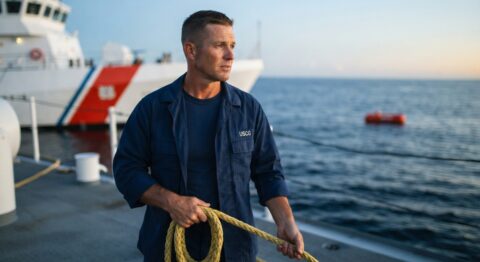
Not quite Navy, not quite police, and often overlooked entirely in the uniform conversation — gay Coast Guard dating draws on a branch of service that’s genuinely different from the rest of the military, and that difference is exactly what makes the fantasy distinct.
A branch that legally sits apart from the rest
The US Coast Guard was established in 1790 by Alexander Hamilton, making it the country’s oldest continuous seagoing service — older than the Navy as it exists today. Since 2003 it’s operated under the Department of Homeland Security rather than the Department of Defense, which technically makes it a law enforcement agency as much as a military branch during peacetime. Under Title 14, Section 3 of the US Code, the President can transfer the Coast Guard to the Department of the Navy during wartime — a provision that exists on the books but hasn’t actually been used since the Second World War. That dual identity, half military, half law enforcement, is part of what makes this uniform read differently from an Army or Navy one.
A formal LGBTQ+ community, only a few years old
Institutional recognition here is genuinely recent. In March 2023, the Coast Guard formalized Spectrum as its official LGBTQ+ affinity group through a signed memorandum of understanding — a real, dated milestone, not a vague gesture. The Coast Guard Academy runs its own parallel network, CGA Spectrum, specifically supporting LGBTQIA+ cadets during training. Even with that structure now in place, the service has been candid that it doesn’t actually track how many LGBTQ+ members currently serve — a reminder that formal recognition and full visibility are two different stages, and this branch is still fairly early into the second one.
A rescue-first identity, not a combat one
Where the appeal of an infantry uniform often leans on discipline and danger, the Coast Guard’s day-to-day work centers on search and rescue, vessel inspection, ice patrol, and coastal law enforcement — protecting people rather than engaging an enemy. That identity isn’t theoretical: Coast Guard crews were among the most visible responders during Hurricane Katrina, credited with rescuing more than 33,000 people from flooded homes and rooftops in the days after the storm, entirely separate from any combat mission. For a lot of GayCharlie members, that rescue-first identity is precisely the draw: strength and competence built around saving lives, closer in spirit to a firefighter than a soldier, but with its own uniform and its own culture entirely.
A smaller, tighter-knit service
The Coast Guard is by far the smallest of the US armed services, which means postings are fewer and further between, and the community within it is correspondingly close. That has real dating implications: a gay Coast Guardsman stationed at a remote cutter port or a small coastal station often has genuinely limited local options, generalist app or not — which is exactly the kind of gap a platform with wider geographic reach exists to close.
Deployment patterns that don’t match a normal dating rhythm
Coast Guard cutters can spend weeks at sea on patrol, ice-breaking missions, or drug interdiction operations, often with limited connectivity the entire time. That’s a very different rhythm from a desk job’s daily availability, and it’s part of why so many members drawn to this fantasy also understand, going in, that replies might take a while — and that’s fine.
Real visibility, one officer at a time
Institutional recognition aside, individual visibility has grown too. Lieutenant Kelli Normoyle entered the Coast Guard Academy in 2008, back when “Don’t Ask, Don’t Tell” was still active policy and being openly gay would have meant risking her entire career before it started. She’s since become a prominent, openly gay Coast Guard officer, currently serving as Commanding Officer of the Coast Guard Cutter Sanibel — a command position, not a desk job, built over a career that began under the exact policy this site covers elsewhere. Her trajectory, entering under DADT and commanding a cutter openly gay years later, is a fairly direct measure of how much has shifted within a single career span.
Two kinds of attraction, both legitimate
Some members are specifically hoping to meet someone who actually serves in the Coast Guard. Others are drawn more to the identity itself — search-and-rescue heroism, a service that saves lives rather than takes them, a uniform that reads as protector first. GayCharlie doesn’t rank one motivation above the other.
Discretion built around a genuinely small world
Because the Coast Guard is so much smaller than the other branches, and its LGBTQ+ community structure is still young, discretion matters even more than usual — word travels fast in a tight community that’s only just started building formal support networks. Neutral profile photos, a private album revealed only when you choose to, and no public location data are exactly the tools built for a service this size, at this stage of its own visibility.
Meeting a gay Coast Guardsman starts here
Whether you searched “gay Coast Guard dating,” you’re drawn to the rescue-first identity specifically, or you’ve just always had a soft spot for the branch everyone forgets to mention, this is a real, distinct part of military life — worth its own space, not a footnote to the Army or Navy, and with its own community only recently starting to organize openly.